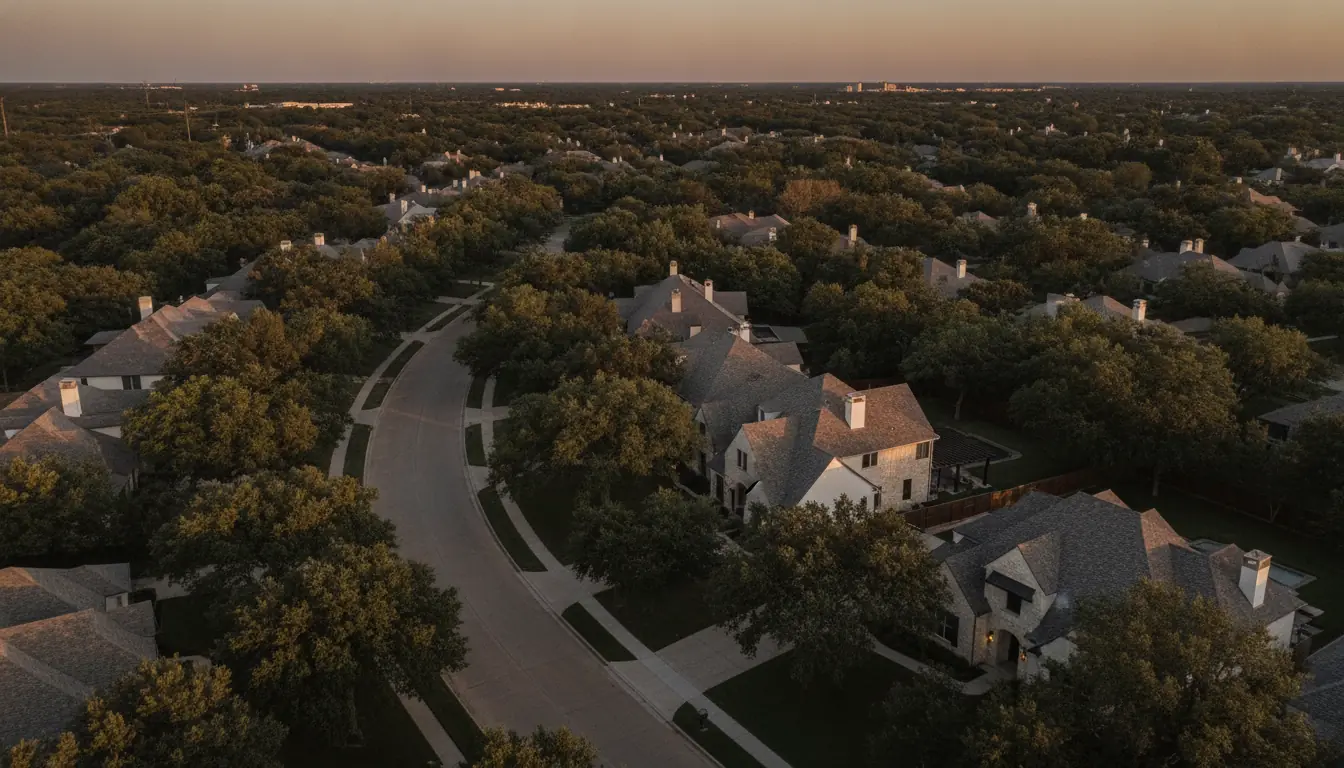
Plano is our home market, and it has a distinct remodeling character because its housing stock was built in a distinct window. The city was largely rural until Dallas suburbanised northward in the 1970s, and the great majority of its homes went up in the decades that followed — the median Plano house dates from the early 1990s.
That produces a specific and very consistent set of projects. These are structurally sound, well-built houses on generous lots, with floor plans drawn to a philosophy nobody uses any more and finishes that have now had thirty-odd years of family life. Most Plano remodels are not repairs. They are a house with good bones being brought forward two decades.
The Plano floor plan, and why everyone wants it opened
Houses built here through the late 1980s and 1990s were designed around separated rooms. A formal living room at the front that nobody sits in, a formal dining room used twice a year, a kitchen closed off from the family room by a wall and often a peninsula, and a breakfast nook that is the only place anyone actually eats. It was a sensible plan for how households were expected to live in 1991.
The overwhelming majority of Plano renovation requests we receive are some version of undoing it: take out the wall between the kitchen and the family room, lose the peninsula, put in an island, and let the whole back of the house become one space. It is the single highest-impact change available in this housing stock, and it is nearly always achievable — but it is structural work first and kitchen design second.
The wall in question is frequently load-bearing. In the simple gable framing common to these houses, an interior wall running perpendicular to the ceiling joists is often carrying them, and removing it means an engineered beam sized for the span with posts carrying load down to the foundation. That is routine, and the answer is almost always yes — but the beam has depth, which affects ceiling height, and the posts have to land somewhere, which affects the island you were planning. That is why this question gets answered before cabinets are drawn, not after.
The other thing inside those walls is the mechanical system. Plano-era construction routinely runs ductwork, plumbing vents and electrical through exactly the wall you want gone. Rerouting is ordinary work and entirely plannable — but it is real scope, and it is one of the most common things missing from an optimistic estimate.
What a house of this era usually needs
These come up repeatedly in Plano homes reaching or passing the thirty-year mark. Not every house has all of them, and none of them are defects — they are simply components and design choices reaching the end of their useful life together.
- Kitchens at the end of their run
- Original cabinet boxes are often still sound while doors, hinges and drawer slides are worn out. Whether refinishing or replacement is the right answer depends entirely on the condition of the boxes, particularly at the sink base.
- Bathrooms with the era's signature layout
- Large garden tubs nobody uses, separate small showers, and cultured-marble surfaces. The most requested change is converting that footprint into a single generous walk-in shower.
- Ceiling texture
- Heavy texture and popcorn ceilings date a house more than almost anything else. Removal is dusty, straightforward work and transforms a room. On houses of this age, have material tested before disturbing it if its history is unknown.
- Original windows
- Thirty-year-old units with failed seals and worn hardware. Replacement improves comfort noticeably in North Texas summers, and is often done alongside exterior work.
- Flooring in several eras
- Most Plano homes of this age have had flooring replaced piecemeal, room by room, producing four different surfaces and a transition strip at every doorway. Running one floor continuously is the single strongest visual change available.
- Electrical capacity
- Panels sized for how a house was used in 1991 now run a very different load. Adding circuits during a remodel is routine; a full panel is a larger item that should be identified before contract.
Mature trees, clay soil, and what the cracks mean
North Texas sits on highly expansive clay that swells when wet and shrinks as it dries, on a seasonal cycle. Slabs move with it. In Plano that general condition is intensified by something that makes the older neighbourhoods so pleasant to live in: mature tree cover.
Large trees draw substantial moisture from the soil around them, particularly through a dry summer. A big tree close to the house can dry the clay on that side while the other side stays comparatively moist, and it is that difference across the slab — rather than movement itself — that shows up inside as doors that will not latch, hairline cracks running diagonally from door and window corners, and floors that are no longer flat.
Not every crack is a problem. Hairline cracking at openings is extremely common in this housing stock and is frequently seasonal — it opens in late summer and closes again after the rains. What warrants a proper look is cracking that is widening year on year, doors that have gone from sticking to unusable, visible slope, or stair-step cracking in exterior brick.
We raise this on Plano projects because it has a direct bearing on scope. Installing new flooring, trim and cabinetry over a foundation that is actively moving is money spent twice, and we would rather tell you that before quoting than after installing. Where movement is present and stable, we plan for it — measuring the floor rather than assuming it, and scribing long runs to what is actually there.
Renovating versus moving in this market
It is a fair question and worth thinking about honestly. Plano's appeal is substantially about location, lot size, established neighbourhoods and mature trees — none of which you take with you, and none of which a newer house further north can offer at the same price.
What a 1990s Plano house genuinely cannot give you without work is an open plan, a kitchen designed for how people cook now, and bathrooms without a garden tub. Those are all things a renovation can deliver, on a lot and in a location that would be expensive to replace.
Where we would be straight with you: if the house has unresolved structural movement, or if what you actually want is significantly more square footage than the lot and setbacks allow, the arithmetic can favour moving. We will say so. We would rather give you an honest read than sell you a project that does not solve your actual problem.
The work Plano homes ask for most
- Kitchen remodelingOpening the kitchen to the family room, cabinetry grades and the sequence a kitchen runs in.
- Bathroom remodelingConverting the garden-tub-and-small-shower layout into a single walk-in shower.
- Full home remodelingWhen the whole first floor is being reworked as one project rather than room by room.
- Framing and structural workLoad-bearing walls, engineered beams and what it takes to open a closed plan.
- FlooringReplacing four eras of flooring with one continuous floor.
- FriscoA very different housing stock a few miles north — and a different set of projects.
What Plano homeowners call us for
Kitchen Remodeling
From cabinet refresh to full gut-and-relayout — the room that sells houses and runs family life, done by one accountable team.
Bathroom Remodeling
Tub-to-shower conversions, primary bath overhauls and hall-bath refreshes — waterproofed right, because that's the part you can't see.
Full Home Remodeling
Whole-house renovation under one contract — design decisions, demolition, trades and finish work sequenced by one team.
All 27 servicesThe full remodeling menu, in Plano
Every service we offer runs in Plano — the ones above are simply what this market asks for most. Highlights: full home remodeling, kitchen remodeling, bathroom remodeling, room additions, roofing, flooring.
Plano questions, answered
- How fast can you come out for an estimate in Plano?
- Fast — Plano is our home city, so estimates here slot in quickest, often within a day or two of your call. Tell us the rooms involved and we'll bring the right questions.
- Do Plano remodels need permits?
- Structural changes, additions and most plumbing/electrical work do; cosmetic updates generally don't. We handle Plano's permit process ourselves — drawings, submission and inspections are part of the job, not your homework.
- Is it worth remodeling a 1980s Plano home or should we move?
- That's really a numbers question, and the numbers usually favor remodeling here: the neighborhoods are established, the lots are bigger than new construction offers, and the bones of these houses are good. We'll give you an honest scope and price so you can compare it to what moving actually costs.
Where Plano sits in our territory
Nearby communities we serve
Planning a remodel in Plano?
Let's talk about your project — a scoped, written estimate is free anywhere in DFW.